Online English Classes and Government-Supported ESL Programs in the USA
Explore online English classes and government-supported ESL programs in the United States for adults aged 18 and older, including immigrants, newcomers, and non-native English speakers. Learn about course highlights, beginner-friendly lessons, adult education funding, age-based course topics for adults 18 and older, and how to find local enrollment options.
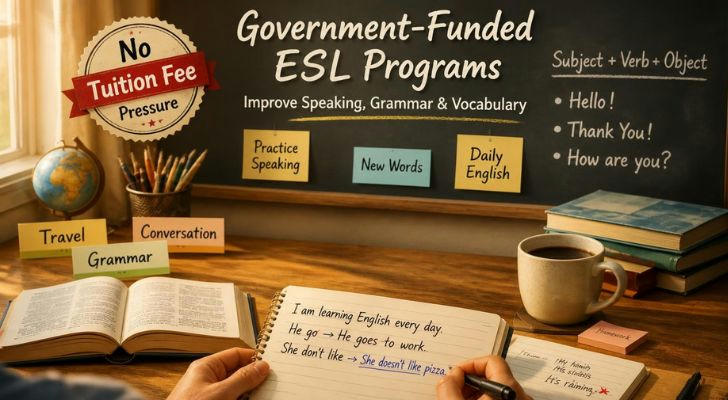
Government-Funded ESL Programs
Government-funded ESL programs help adults in the United States improve their English through publicly supported adult education services. Supported by federal funding under AEFLA, Title II of WIOA, these programs are delivered through eligible state and local providers.
Courses may cover speaking, listening, reading, writing, grammar, and everyday communication. Depending on the provider, classes may be offered online, in person, or in a hybrid format.
Government-Funded ESL Program Highlights
Government-supported ESL programs may provide adult learners with access to structured English language instruction and educational resources.
-
Publicly Supported Learning: ESL classes are supported through federal and state adult education funding,no tuition fee pressure.
-
Online and Virtual Instruction: Certain local providers offer remote or hybrid English classes, depending on program availability.
-
Practical English Skills: Lessons may cover speaking, listening, reading, writing, pronunciation, grammar, and vocabulary.
-
Workplace Communication: English instruction may help learners develop language skills for employment-related communication and everyday workplace situations.
-
Flexible Learning Options: Some providers offer different class schedules, including daytime and evening sessions.
-
Learning Outcomes and Employment Support: Upon completing the course, students will receive a professional certification and gain access to employment support services, such as career guidance and job placement assistance.
-
Adult Learner Support: Programs may provide placement assessments, instructor guidance, and learning resources based on students' English proficiency.
Important: Government funding does not mean every ESL course is online or available to everyone. Each local provider determines its course formats, eligibility requirements, enrollment procedures, and available services.
Beginner-Friendly English Learning
Many adult English courses are designed for learners who are starting with basic vocabulary and everyday expressions, including immigrants, newcomers, and non-native English speakers who want to improve their English skills for daily life, work, and community integration. Depending on the program, students may begin with an assessment to identify their current level and find an appropriate class.
Introductory lessons commonly cover:
-
Greetings, introductions, and asking basic questions
-
Numbers, dates, times, and everyday vocabulary
-
Understanding simple spoken instructions
-
Reading signs, forms, labels, and short messages
-
Writing basic sentences and completing common forms
-
Pronunciation and listening practice for daily conversations
These lessons can be particularly helpful for immigrants adjusting to an English-speaking environment, communicating with local communities, accessing public services, and preparing for employment. Learners with more experience may be able to join intermediate or advanced classes that focus on longer conversations, workplace communication, reading comprehension, writing, and academic or career-related language.
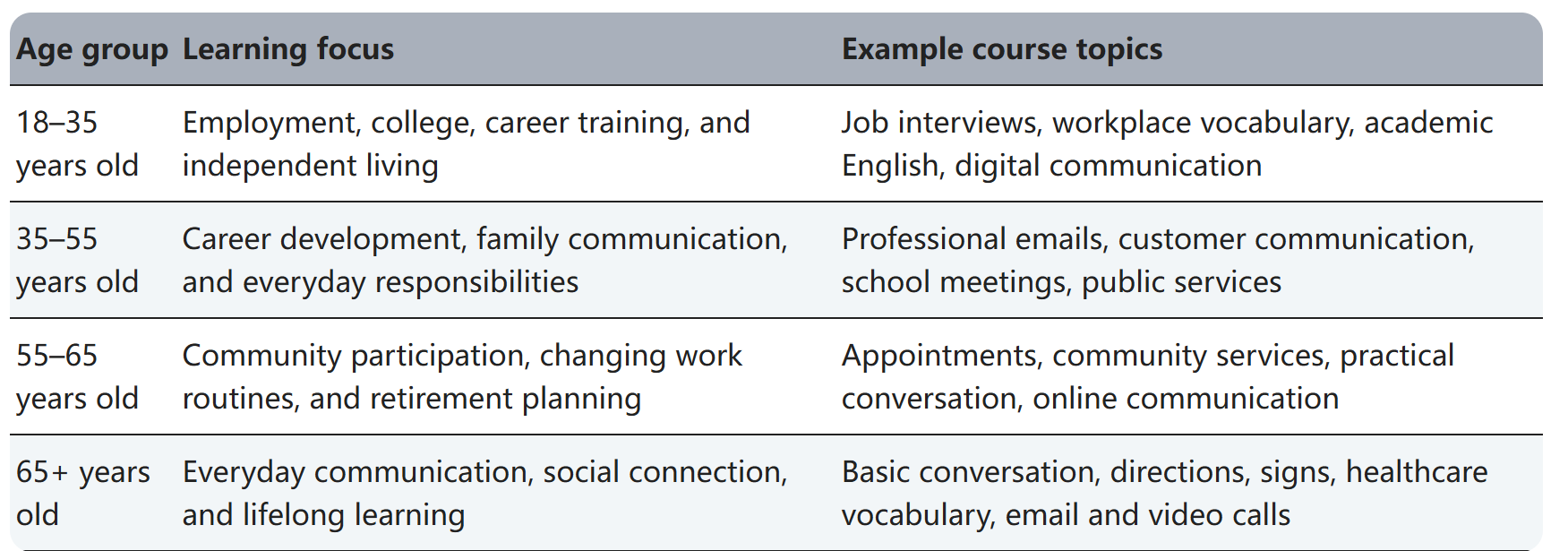
English Course Guide by Age Group
The age ranges below are intended to help adults identify course topics that may match their goals. They are not separate federal program categories or guarantees of eligibility. Placement is generally based on English proficiency, educational needs, and the requirements of the local provider.
English Language Skills and Learning Outcomes
English courses may cover several connected skills. A balanced program usually provides opportunities to practice more than one area of language development.
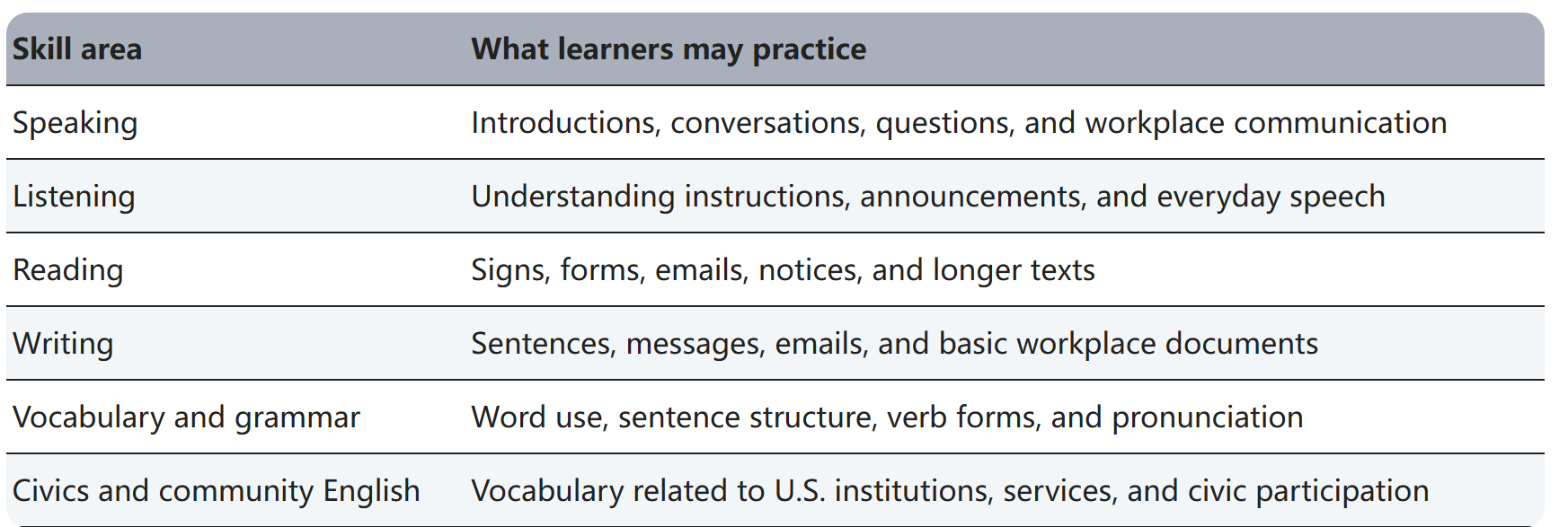
Some adult education programs connect English instruction with employment preparation, career pathways, or civics education. The exact curriculum depends on the provider and funding arrangement.
Who Can Apply for Government-Supported ESL Programs?
There is no single application process for every ESL program in the United States. Under WIOA Title II, AEFLA-supported services are intended for eligible adults and out-of-school youth. Federal law identifies English language learners as one category of eligible individuals, while states and local providers administer enrollment and program requirements.
Depending on the program, applicants may be asked to:
-
Complete an intake form or attend an orientation.
-
Take an English language or literacy placement assessment.
-
Provide information needed to determine program eligibility.
-
Confirm the class schedule and available learning format.
-
Ask whether virtual participation is offered and what technology is required.
The age ranges in this guide are learning-planning categories, not official eligibility bands. Adults should check directly with the provider about residency, documentation, age, education, and other local requirements.
How to Find and Enroll in English Classes
Interested learners can use official government resources and local education providers to identify current classes.
1. Check your state adult education agency.
Search for your state’s adult education office or department of education. Look for terms such as Adult Education and Literacy, English Language Acquisition, Adult ESL, WIOA Title II, and English Literacy and Civics Education.
2. Contact local colleges and adult learning centers.
Community colleges, school districts, adult schools, libraries, and nonprofit organizations may offer English instruction. Ask whether enrollment is open and whether online, in-person, or hybrid classes are available.
3. Review online English learning resources.
USALearns provides online English lessons and practice in areas such as speaking, listening, vocabulary, pronunciation, reading, writing, and grammar. It can be used as an independent learning resource; it is not the same as enrolling in a local government-supported class.
4. Ask about placement and course levels.
Find out whether the provider offers beginner, intermediate, or advanced instruction and whether an assessment is required before placement.
5. Confirm costs and attendance requirements.
Ask about tuition, books, testing, technology, attendance expectations, class dates, and any other enrollment conditions before registering.
Frequently Asked Questions
Can I find affordable or government-supported online English classes in the USA?
Yes. Adults can find self-paced lessons, live virtual classes, and hybrid instruction through online learning platforms, schools, community organizations, and adult education providers. Availability and costs vary.
Can I learn English online if I have a busy schedule?
Yes. Federal funding through AEFLA, Title II of WIOA, supports state and local adult education and literacy services, which may include English language acquisition. Local providers determine the classes available and the enrollment requirements.
Can beginners and adults over 55 or 65 enroll in English classes?
Many adult education providers offer beginner-level English instruction for adults with different learning needs. Previous English experience may not be required, and older learners may also find suitable programs. Class availability, age requirements, and placement procedures depend on the local provider.
Explore English Learning Options
Online lessons can provide flexible practice, while local adult education providers may offer structured ESL instruction and, in some cases, services supported by public funding. Start by identifying your learning goals and current English level, then contact providers in your state to confirm available classes, enrollment requirements, schedules, and costs.
Explore online English learning resources and ask a local adult education provider about current ESL classes and virtual learning options.