NHS Dental Care Services and Updates: A Practical Guide for 2026
This guide walks through NHS dental care as it stands now, including the June 2026 hospital expansion for adults 50 and over, how charge bands work, what support may be available, and where private pathways fit when the public route is blocked.
NHS Dental Care Services and Updates: The June 2026 Hospital Expansion
The most discussed NHS dental update for older adults is the planned expansion starting in June 2026. According to the announcement framing this programme, forty-eight hospitals will provide dental care—including implants, dentures, and general dental services—to people aged 50 and over. That is a structural shift: hospital-based pathways for complex restorative work that many practices have struggled to deliver on the high street under current capacity.
Think of it as restoring function first. Chewing, speaking, and comfort are not cosmetic luxuries; they sit at the base of long-term vitality. The expansion targets adults who have deferred treatment for years and now need more than a quick scale and polish.
Who the 50+ pathway is aimed at
The programme language focuses on people aged 50 and over who need implants, dentures, or broader restorative dental services. If you are managing missing teeth, failing restorations, or dentures that slip and sore the gums, this is the cohort the update is designed around. Exact local referral rules will sit with hospital teams and integrated care boards, so treat the age threshold as the headline eligibility signal rather than a finished checklist.
What treatments are expected under the hospital route
The announced scope includes implants, dentures, and general dental services. In plain terms, that spans fixed and removable tooth replacement plus routine assessment and treatment that may feed into specialist work. NHS hospital dentistry has long handled complex cases that general practices refer on; the 2026 framing simply puts a clearer age-focused doorway on that capacity for older adults.
That said, hospital lists still move at the pace of clinical priority. If you are in severe pain or have swelling that affects breathing or swallowing, urgent and emergency routes remain the first call—do not wait for a 2026 referral window to open.
How this NHS dental update sits alongside high-street care
High-street practices remain the front door for most NHS dental care. Hospital pathways typically follow assessment and referral when work is complex, capacity is limited, or special care needs apply. Large mixed providers such as mydentist continue to offer NHS and private appointments in many towns; asking clearly for an NHS slot at first contact still matters, because some sites run dual lists.
Until June 2026, the practical play is twofold: keep searching for a practice that will accept you, and ask your local integrated care board what hospital or community dental services already accept referrals for complex restorative needs in your area.
Understanding NHS Charge Bands and What You Actually Pay
Most adults in England pay for NHS dentistry unless they qualify for free care or help with costs. Charges are grouped into bands. You pay the highest band once if treatments from different bands are needed in the same course of care. Further treatment in the same or lower band within two months usually does not trigger an extra charge.
Band 1, Band 2, and urgent care in plain English
Band 1 covers examination, advice, X-rays when needed, and simple gum management such as scaling when clinically necessary. The current published figure sits at £27.90. Urgent dental treatment is also charged at the Band 1 level and can include temporary dressings, limited extractions, abscess drainage, and emergency adjustments to dentures or appliances.
Band 2 currently stands at £76.60 and adds fillings, root canal treatment, extractions, and more extensive gum care. White fillings on the NHS are provided when clinically appropriate; back teeth may still be restored with amalgam when that is the more durable clinical option. Your dentist should explain the trade-offs before you decide.
Band 3: crowns, bridges, dentures, and the implant question
Band 3 is the heavy restorative band. The published charge is £332.10 and can include crowns, inlays and onlays, plastic or metal dentures, bridges, and certain orthodontic appliances when clinically necessary. For many pensioners, that single figure is the one that stings—especially when several teeth need work over time.
Implants sit in a grey zone of public expectation. The June 2026 hospital announcement specifically names implants among the services for adults 50 and over, which is why this NHS dental update has drawn so much attention. In everyday high-street practice, full private implant pathways remain common when NHS provision is not available. Always ask for a written treatment plan for Band 2, Band 3, or mixed NHS and private care so you can see what is clinical necessity versus elective upgrade.
Help with costs and free care
Some people do not pay at all, including those on certain benefits or with qualifying low income, and specific free items such as stopping bleeding, removing stitches, or repairing dentures that can be fixed rather than remade. If you receive Pension Credit or other support, check help-with-health-costs routes before you assume the full Band 3 bill is yours. A quiet habit of asking early saves more stress than any last-minute scramble at the reception desk.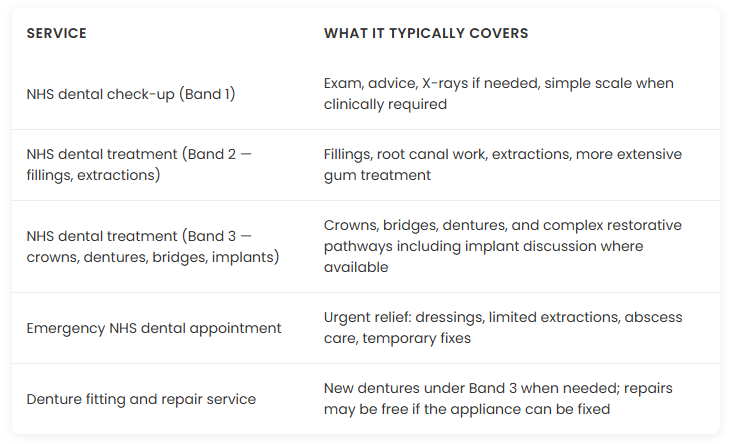
How to Find NHS Dental Care When Practices Are Full
The daily reality for many UK adults is simple and frustrating: every local practice says it is not accepting new NHS patients. That is not a personal failing. Capacity and contract design have left large areas underserved. The goal is to keep pressure on the system while protecting your own mouth in the meantime.
A practical sequence when you cannot register
- Search the official NHS find-a-dentist tool and call practices that still list NHS availability—ask for an NHS appointment specifically.
- Join waiting lists where offered; registration at a first visit does not guarantee ongoing NHS care at the same practice forever, but it is still a foothold.
- Contact your local integrated care board if you cannot find any appointment; ICBs commission dental services and may know community or urgent access schemes.
- Use urgent pathways for severe pain, facial swelling, trauma, or uncontrolled bleeding rather than waiting for a routine slot that may never appear.
- Keep a short written record of calls and dates; it helps if you later need advocacy through patient advice services.
Networks such as Bupa Dental Care and Portman Dental Care operate widely across the UK with mixed NHS and private models. Availability varies by site, so treat brand presence as a starting map, not a guarantee of open NHS books. The same discipline applies whether you ring a single-surgery practice or a multi-site group.
When private or hybrid care becomes the bridge
If years of deferred care have left you with failing teeth, a hybrid plan is often the realistic middle path: stabilise infection and pain wherever you can on the NHS, then sequence larger restorative work as funds and slots allow. Payment plans through providers such as Denplan or health cash plans from Simplyhealth can spread private costs for check-ups, hygiene, and treatment top-ups—useful when you are waiting for hospital capacity or still hunting for an NHS home.
You can go more aggressively private if that fits your budget. You can also stay minimal and focus only on infection control. Both are valid. The evolutionary lens is simple: keep the mouth functional so you can eat protein and fibre-rich food without pain. Everything else is sequencing.
Special care and hospital referrals
If you or someone you support has additional needs, general practices should still be the first attempt for NHS care. When specialised treatment is required, referral into special care dentistry or hospital oral and maxillofacial pathways may follow. Long waits are common for non-urgent specialist work—another reason the 2026 hospital framing for adults 50 and over has become a focal point for people who already feel stuck in the queue.
Dental Implants, Dentures, and Affordable Options Beyond the Basic Band
Tooth loss changes how you eat, how you speak, and how you show up in a room. Our ancestors lost teeth too, but modern materials give you choices they never had: well-fitted full or partial dentures, bridges, single implants, or full-arch solutions. The CPC-relevant questions people actually type—affordable dental implants, dental implant cost, all on 4 dental implants cost, full mouth dental implants—sit right next to the NHS conversation because public capacity has not kept pace with demand.
NHS dentures versus private implant pathways
On the NHS, clinically necessary dentures and bridges sit inside Band 3. Many people do well with well-made removable appliances, especially when ridges are stable and the fit is adjusted carefully. Others chase a fixed solution because dentures slip, reduce bite force, or trigger sores. Private clinics advertise affordable dental implants and package pricing for single-tooth and multi-unit work; figures vary widely by region, bone grafting needs, and lab quality. Treat headline prices as a starting conversation, not a final invoice.
Full-arch concepts often marketed as all on 4 dental implants replace a full upper or lower set of teeth on a small number of implants. Private dental implant cost for that route is typically a multi-thousand-pound decision, not a Band 3 equivalent. If the June 2026 hospital list includes implant provision for over-50s in your area, ask early how clinical need is assessed and whether grafting or sedation is included in the pathway description.
Comparing cost conversations without the hype
People also search terms such as cheap dental implants, $399 dental implants, and clear choice dental implants cost when they are price-shopping online. Those phrases usually reflect US-style marketing and loss-leader offers that may not map cleanly to UK clinical standards, aftercare, or lab work. A better frame for UK readers is total cost of ownership: surgery, temporary teeth, final prosthesis, reviews, and what happens if an implant fails years later.
- Single implant — replaces one tooth; useful when neighbours are healthy.
- Implant-supported bridge — spans several missing teeth without a removable plate.
- Implant-retained denture — a middle path that improves stability over a conventional full denture.
- Full-arch fixed bridge — the all-on-4 style solution for extensive tooth loss.
- Conventional full or partial dentures — still the most common NHS Band 3 answer when fixed work is not available.
Home brands you already know—Colgate, Oral-B, Sensodyne, and Corsodyl—will not replace missing teeth, but they matter for keeping remaining teeth and gums stable while you wait. Sensitive-tooth formulas, interdental cleaning, and short courses of antimicrobial mouthwash when a clinician recommends them are the low-drama habits that protect whatever investment you eventually make in implants or new dentures.
Insurance-style and plan language you may see online
UK readers often encounter US-centric plan names in search results—Aetna dental, Cigna dental, UnitedHealthcare dental, Blue Cross Blue Shield dental—because global ad networks do not respect borders. Those products are not the default framework for NHS England charges. Closer to home, employer schemes, cash plans, and practice membership models shape what you pay privately. If you hold any dental plan, read the annual maximums and waiting periods before you commit to full mouth dental implants or extensive crown work.
Building a Steady Plan While You Wait for Better Access
Access gaps create a dangerous pattern: ignore the mouth until pain forces an emergency visit, then accept whatever temporary fix is available. A better pattern looks like ancestral common sense applied to a modern system—protect function daily, fix infection early, and sequence larger rebuilds when the door opens.
Daily habits that buy you time
Twice-daily brushing with a fluoride toothpaste, interdental cleaning, and a diet that is not constantly bathing teeth in sugar are still the highest return moves available without a dentist. If gums bleed, do not stop cleaning them; bleeding is a signal to clean more gently and more consistently, then seek professional assessment when you can. Electric brushes from established lines and sensitivity pastes are tools, not magic—use them because they make the habit easier to keep.
Questions worth asking at every appointment
- Is this treatment clinically necessary on the NHS, or is it being offered privately as an alternative?
- What is the band charge for this course of care, and will I receive a written treatment plan?
- If implants or complex dentures are needed, what is the referral route and expected wait?
- What can I do at home in the next three months to stabilise the situation?
- If I cannot afford Band 3 now, what is the minimum sequence that removes infection and restores chewing on one side?
Those questions keep you in the driver’s seat. They also surface whether a practice is primarily an NHS gateway or a private conversion funnel—information you deserve before you sit in the chair.
Looking past the headline to related choices
As hospital capacity for older adults expands, related topics will matter more: waiting-time transparency, community dental services for special care, how Band 3 charges interact with pension income, and when private dental clinic pathways for dental implants near me searches are worth the spend. None of that replaces the core job of NHS dental care—clinically necessary treatment to keep the mouth healthy—but it does explain why so many people now research both systems side by side.
You are not behind. You are course-correcting in a system that has been under strain. Start with the next available clinically necessary step, keep the daily habits simple, and treat the June 2026 hospital expansion as one more door to watch—not the only door that counts. That is enough for today.