Can You Really Get Into Healthcare With an Online Course?
An online healthcare course can be a faster and more flexible way to start learning, but the quickest course is not always the most useful one for your career goal. Before choosing a program, compare three things: how quickly you can finish, how much of the training can be completed online, and whether the course actually fits the requirements of the healthcare role you want.
The Healthcare Course Trap: Fast, Flexible, or Career-Relevant?
If you are thinking about moving into healthcare, there is an obvious problem.
You may not want to spend years going back to school.
You may already have a job, family responsibilities, or a schedule that makes regular classes difficult.
At the same time, you probably don't want to spend your money on an online certificate that looks useful but does little for the type of healthcare work you actually want.
That creates a difficult trade-off.
You are usually looking for three things:
Finish quickly.
Study flexibly.
Get training that is actually relevant to a healthcare career.
Finding all three in one program is not always straightforward.
Why the Fastest Course Isn't Always the Fastest Route
A short online course can look like the obvious choice.
You can start quickly, study from home, and potentially finish in a matter of weeks or months rather than committing to a much longer program.
But there is an important distinction between finishing a course and completing the training needed for a particular healthcare role.
Some healthcare positions involve practical skills, supervised experience, examinations, registration, or other requirements.
An online course may cover the theory without covering every part of that pathway.
So a course that takes four weeks to complete isn't necessarily a four-week route into the occupation you have in mind.
The question to ask is:
What does this course actually qualify me to do?
The Online Advantage — With One Catch
Online learning solves a real problem.
You can often study around:
- Full-time work
- Family responsibilities
- Other education
- Irregular schedules
- Long commutes
For someone changing careers, that flexibility can be extremely valuable.
But “online” can mean different things.
One program may be entirely self-paced.
Another may offer online theory but require practical training in person.
Another may simply provide an educational certificate without being designed as a professional qualification.
That's why the course format should never be your only comparison point.
Look for:
Online theory
Practical training
Clinical or supervised experience
Assessment
Certification or registration requirements
The combination matters more than the word “online.”
The Certificate Question Most People Miss
A course can give you a certificate without being the same thing as a professional license or regulated qualification.
This distinction becomes especially important when comparing programs across different countries.
A healthcare assistant, nursing assistant, care worker, or similar role may have different names and requirements depending on where you live.
A qualification that is relevant in one location may not automatically satisfy requirements somewhere else.
So instead of asking:
“Is this course certified?”
ask:
“Who recognizes this qualification, and what is it intended to qualify me for?”
That single question can eliminate a lot of unsuitable courses.
What Are You Actually Paying For?
Two courses can have similar prices but provide very different things.
When comparing programs, look beyond tuition.
Check whether the price includes:
- Course materials
- Assessments
- Practical training
- Examination fees
- Registration costs
- Required equipment
- Additional training hours
A low advertised price can become much less attractive if important parts of the training have to be purchased separately.
Likewise, a more expensive program may include components you would otherwise have to arrange yourself.
The useful number is the total cost of reaching your intended training outcome, not simply the number displayed next to “course fee.”
The Three-Way Choice
This is where the decision becomes clearer.
Fast
You want to complete training quickly.
Flexible
You need to study around your existing life.
Career-relevant
You want training that actually fits the healthcare role you are considering.
A program might be excellent for speed but weak on practical training.
Another might be highly relevant but require a fixed schedule.
Another might be completely flexible but provide only general healthcare education.
There is no reason to assume that the program with the shortest duration is automatically the best fit.
The important question is:
Which part of the triangle are you least willing to compromise on?
Start With the Job, Not the Course
This is probably the most useful way to narrow your options.
Instead of searching for:
“cheap online healthcare course”
start with the type of work you are interested in.
For example:
- Healthcare assistant
- Nursing assistant
- Care assistant
- Care worker
- Patient support
- Aged-care support
Then check what that occupation requires where you live.
Only after that should you compare courses.
This prevents a common mistake: choosing a convenient course first and discovering later that it does not cover an important part of the pathway you wanted.
A Simple Course Comparison
Before enrolling, compare each program using the same questions:
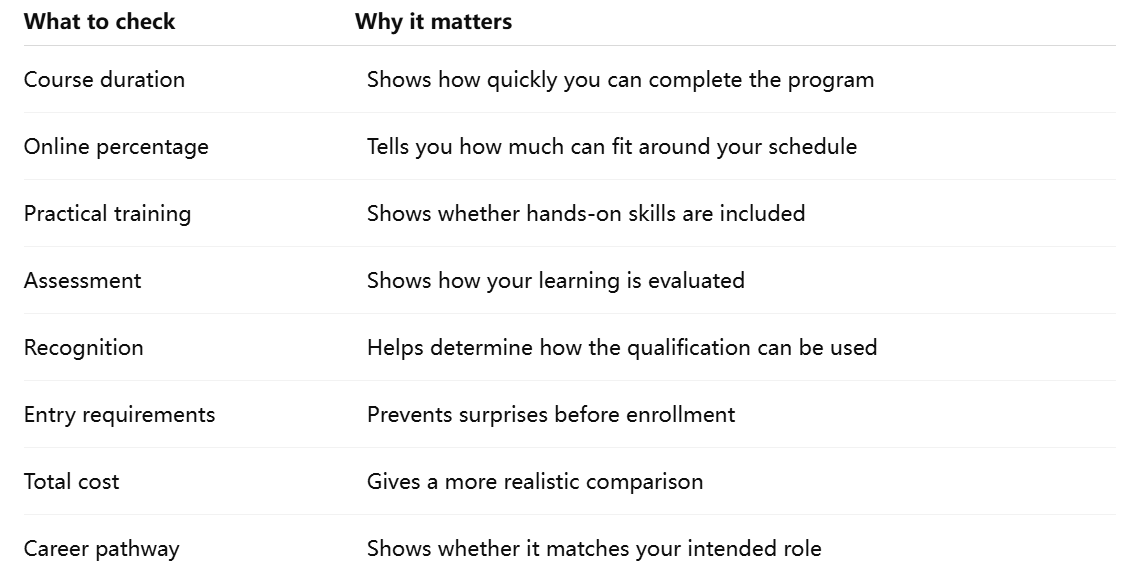
Once you compare courses this way, the cheapest or fastest option may no longer look like the obvious choice.
The Question to Ask Before You Enroll
Don't ask only:
“How quickly can I get this certificate?”
Ask:
“How quickly can I complete training that actually makes sense for the healthcare work I want to pursue?”
That is a very different question.
For some people, a short online introductory course may be exactly what they need.
For others, a program combining online learning with practical training may make more sense.
And for someone targeting a regulated role, the most important factor may be whether the program fits the relevant local qualification pathway.
The right course is therefore not simply the one that promises the fastest certificate.
It is the one whose speed, flexibility, practical requirements, recognition, and total cost match your actual goal.
Before enrolling, compare those factors side by side rather than choosing based on course length alone.