Dental Implants: Options for Replacing Missing Teeth
Missing a tooth can affect your smile, chewing, and everyday comfort. If you have one or more missing teeth, there are several replacement options to consider. Dental implants are one of the most commonly discussed options for replacing missing teeth. The right choice depends on your oral health, the condition of your jawbone, the number of missing teeth, and your treatment goals.
Why Do People Lose Teeth?
Common causes include:
- Tooth decay
- Gum disease
- Accidental injury
- Severe tooth damage
- Natural tooth loss
A missing tooth doesn't always mean you need the same treatment as someone else.
Common Tooth Replacement Options
Dental Implants
A dental implant uses an implant placed in the jawbone to support a replacement tooth.
An implant can be used to replace:
- One missing tooth
- Multiple missing teeth
- Several teeth with implant-supported restorations
Often considered for: people looking for a fixed tooth replacement option.
Dental Bridges
A dental bridge uses neighboring teeth or other support to replace a missing tooth or teeth.
It may be an option when an implant isn't preferred or appropriate.
Dentures
Dentures can replace several missing teeth or a full set of teeth.
Options may include partial or full dentures depending on how many teeth are missing.
How Do Dental Implants Work?
A typical implant treatment involves several stages:
1. Evaluation
A dentist examines your teeth, gums, and jawbone.
2. Implant Placement
The implant is placed into the jawbone.
3. Healing
The implant needs time to integrate with the surrounding bone.
4. Replacement Tooth
A dental crown or other restoration is attached to the implant.
Treatment time varies depending on the individual case.
Who May Consider Dental Implants?
Dental implants may be considered by people who:
- Have one or more missing teeth
- Want a fixed replacement option
- Have sufficient bone to support an implant
- Have healthy gums or are able to address gum problems
- Want to restore chewing function
Not everyone is an ideal candidate immediately.
A dental evaluation can determine whether implants are appropriate and whether additional treatment is needed first.
Dental Implants vs Other Options
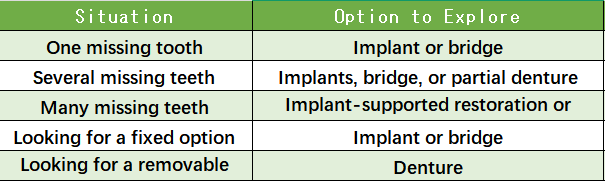
Each option has different benefits, limitations, costs, and maintenance requirements.
How Much Do Dental Implants Cost?
Dental implant costs can vary significantly.
Factors may include:
- Number of implants
- Type of restoration
- Bone condition
- Additional procedures
- Dental provider
- Location
- Insurance coverage
Some cases may require additional procedures before implant placement, which can affect the total cost.
Ask for a complete treatment estimate so you understand what is included.
A Quick Missing-Tooth Check
Missing one tooth?
→ Ask about implants and bridges.
Missing several teeth?
→ Explore implants, bridges, or partial dentures.
Want a fixed replacement?
→ Dental implants may be an option.
Have gum problems or bone loss?
→ You may need an evaluation before considering implants.
Concerned about cost?
→ Compare treatment options and ask about insurance or available payment plans.
Frequently Asked Questions
Are dental implants permanent?
Implants are designed as a long-term tooth replacement option, but their longevity depends on oral hygiene, gum health, lifestyle, and other factors.
Does getting a dental implant hurt?
The procedure is performed with anesthesia. Some discomfort and swelling may occur afterward during the healing process.
Can one missing tooth be replaced with an implant?
Yes. A single dental implant can support a replacement tooth in appropriate cases.
Are implants better than dentures?
They are different solutions. Implants are fixed in the mouth, while traditional dentures are removable. The appropriate choice depends on your individual situation.
Does dental insurance cover implants?
Coverage varies by insurance plan. Some plans may provide partial coverage for certain parts of treatment, while others may not cover implants.
What if I don't replace a missing tooth?
Depending on the location and circumstances, a missing tooth can affect chewing and may contribute to changes in how the remaining teeth function. A dentist can help you understand your options.
The Bottom Line
Dental implants are one option for replacing missing teeth, but they aren't the only choice.
Implants, bridges, and dentures each have different advantages and considerations.
If you're missing a tooth, a dental evaluation can help determine which replacement option may be appropriate for you.